Yes, solar panels need cleaning — but not as frequently as many people assume. In the UK, rainfall handles most light dust and general atmospheric soiling. What rain cannot remove is accumulated bird droppings, spring pollen deposits, tree sap, and in coastal areas like Whitstable, Herne Bay, and Margate, a build-up of salt residue on the glass surface. Research from the Solar Trade Association indicates that dirty panels in UK conditions lose between 5% and 15% of their electrical output. For most Kent homeowners, a professional clean every one to two years is the right interval — more frequently if you’re near the coast, under trees, or in a high bird-traffic area.
Why dirty solar panels lose output
Solar photovoltaic (PV) cells work by converting sunlight into electricity. Any layer of material between sunlight and the panel surface reduces the amount of light reaching the cells. Even a thin film of general atmospheric dust creates a measurable reduction in output. More significant contaminants — hardened bird droppings, thick pollen deposits, autumn leaf residue — can block light to specific cells entirely.
Because solar panel cells are wired in series within a panel, a significant reduction in light reaching even one cell can reduce the output of the entire string — not just that cell. One bird dropping covering a small section of a panel’s surface can reduce output from that panel by considerably more than the area it covers.
The Solar Trade Association’s research puts the output loss from dirty panels at 5–15% in typical UK conditions. On a 4kW system generating approximately £700 per year in savings, a 10% reduction represents £70 of lost value annually. Over five years without cleaning, that’s £350 in avoidable losses — considerably more than the cost of a professional clean.
What causes solar panels to get dirty in the UK?
The main contaminants affecting UK solar panels are:
Bird droppings. The most damaging single contaminant. Bird droppings are acidic and, if left untreated, can affect the anti-reflective coating on panel glass over time. Panels angled at less than 15 degrees are particularly affected because rainwater doesn’t run off with enough force to dislodge hardened deposits. Properties near flat-roofed buildings, mature trees, or water features tend to see heavier bird fouling.
Pollen. Spring in Kent sees significant pollen release from trees and crops across the county’s agricultural land. Unlike dust, pollen is sticky — it adheres to the glass surface and binds with moisture to form a coating that rainfall doesn’t shift. Properties near orchards, arable fields, or mature deciduous trees are particularly affected between March and June.
Tree sap and leaf matter. Deciduous trees shed leaves from September through November. Leaf matter on solar panels breaks down into a dark organic residue that bonds with the panel surface. Autumn leaf fall is the highest-risk period for soiling if your panels are adjacent to or below trees.
Coastal salt. For properties in Whitstable, Herne Bay, Margate, Ramsgate, Broadstairs, and Deal — all areas CleanSweep serves — salt carried in sea air deposits on panel surfaces over time. Salt film reduces light transmission and, like pollen, doesn’t simply wash away in rain. Coastal properties typically need cleaning every six to twelve months rather than every one to two years.
Traffic film. Properties close to main roads see higher levels of atmospheric particulates from vehicle exhaust. These deposit on all exterior surfaces including solar panels, building up a grey film over time that cumulatively reduces output.
Does rain clean solar panels?
Partially. The glass on most modern solar panels uses a hydrophobic coating — a surface treatment that causes water to bead and run off rather than sit on the glass. This means rainfall does carry away loose dust and light debris.
The Energy Saving Trust acknowledges that many solar panel owners in the UK may not need to clean their panels as frequently as manufacturers sometimes suggest, specifically because UK rainfall provides natural cleaning for general atmospheric soiling.
However, rain cannot:
- Remove hardened bird droppings
- Dissolve pollen deposits
- Clear leaf residue and tree sap
- Neutralise salt build-up on coastal properties
- Remove traffic film from roadside locations
Rain also tends to run off in the same tracks down the panel. This means the centre and upper portions may remain relatively clean while the lower edges accumulate a concentrated line of debris at the waterline — visible on older installations as a brownish stripe across the bottom of each panel.
How often should solar panels be cleaned?
The right cleaning interval depends on your property’s surroundings and location:
| Property type | Recommended interval |
|---|---|
| Standard residential, inland | Every 1–2 years |
| Near trees or heavy bird traffic | Annually |
| Agricultural area or high pollen zone | Annually, after peak pollen season |
| Coastal (within 5 miles of the coast) | Every 6–12 months |
| Flat or low-pitch roof (under 15°) | Annually — reduced natural run-off |
If you have monitoring equipment connected to your inverter, you can track output data over time and schedule cleaning when output per kWh starts to diverge from expected seasonal norms. This is more accurate than following a fixed calendar interval — it tells you when cleaning is actually needed rather than when it might be needed.
Signs your solar panels need cleaning now
You don’t need to physically access the panels to spot indicators that cleaning is due. The clearest signs are:
Visible soiling from ground level. Bird droppings, heavy pollen, and leaf residue are often visible from the ground with the naked eye or through binoculars. A patchy or streaked appearance suggests uneven soiling that rainfall has partially cleared but not removed.
Monitoring data showing below-expected output. If your inverter monitoring app or smart meter export data shows lower output than comparable periods in previous years — accounting for seasonal variation — soiling may be a contributing factor. A drop of more than 10% year-on-year during the same season warrants investigation.
Unusually heavy pollen season. Kent’s agricultural landscape means pollen seasons can be significant, particularly in years with warm dry springs. If local pollen counts have been high and your panels are near trees or fields, cleaning after peak season is a sensible step.
Time elapsed. Even without visible soiling, panels that haven’t been cleaned in more than two years are likely carrying a build-up of general atmospheric particulates that monitoring systems won’t easily detect but that cumulatively reduce output.
Can you clean solar panels yourself?
Technically, yes — but it comes with risks that homeowners should understand before attempting it.
Safety. Accessing roof-mounted panels requires working at height. Falls from roofs are a leading cause of serious domestic injury. Unless you have appropriate personal protective equipment, a secure ladder system, and experience of working at height, this is not a DIY task.
Water quality. Tap water contains dissolved minerals — primarily calcium and magnesium — that leave white spots on glass as water evaporates. Cleaning solar panels with a garden hose or tap water connection can leave mineral deposits on the glass surface that actually increase soiling over time. Professional solar panel cleaning uses deionised or demineralised water, which evaporates without residue.
Pressure. High-pressure washers can damage the junction boxes, cabling, and frame seals on solar panels. Manufacturers typically specify that pressure washing voids the panel warranty. Correct cleaning uses low-pressure application with soft brushes, not high-pressure spraying.
For most homeowners, professional cleaning is the right choice — not primarily for convenience, but because the equipment and safety requirements make DIY cleaning either ineffective or risky.
What professional solar panel cleaning involves
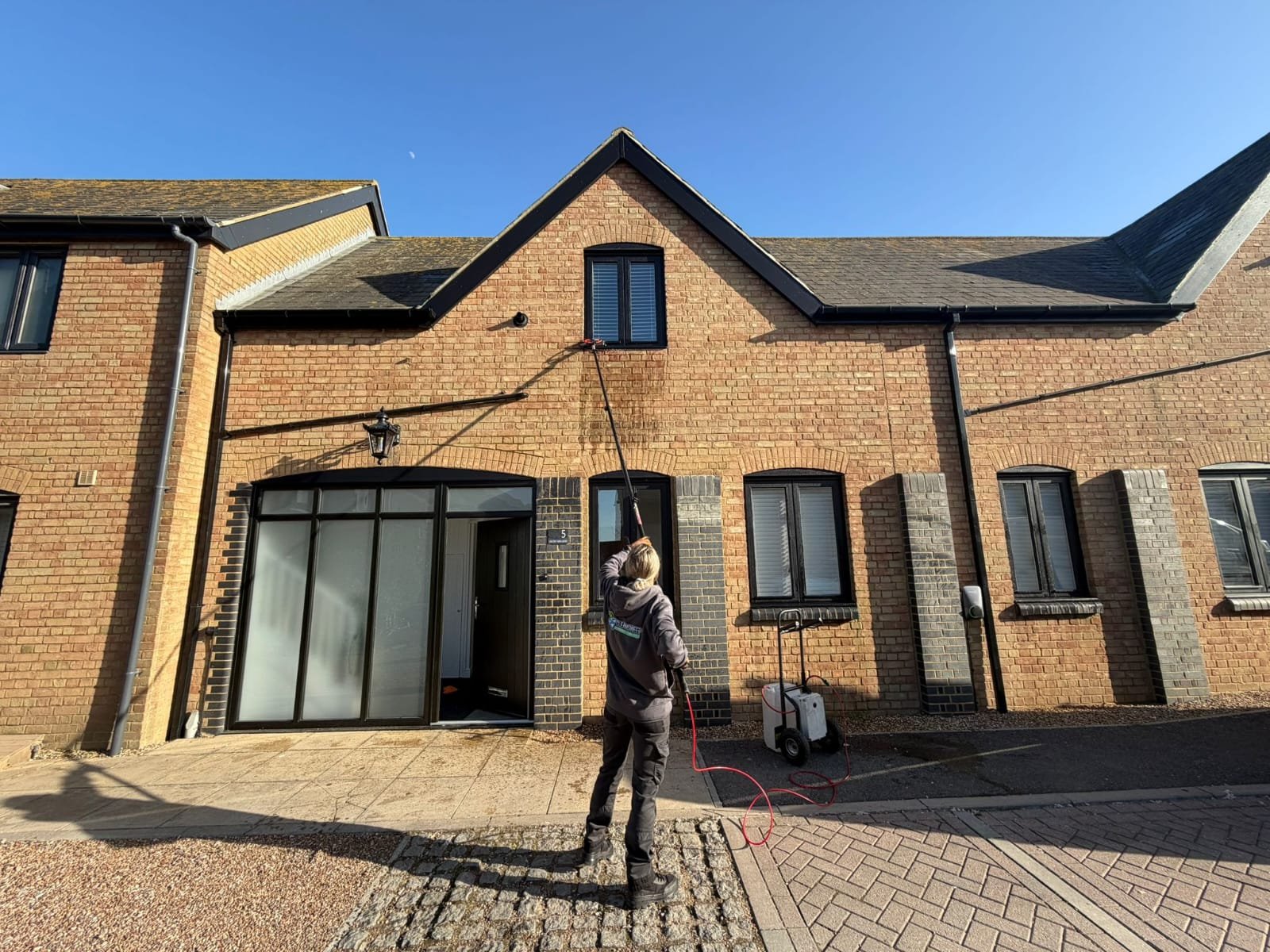
A professional solar panel clean uses deionised or pure water fed through extendable pole systems, allowing the technician to clean panels from ground level in many cases — no scaffolding required for most standard pitched roof installations.
At CleanSweep, we use pure water pole systems for solar panel cleaning — the same technology used for our window cleaning work. Deionised water contains virtually no dissolved minerals, which means it leaves no residue on the glass surface as it dries. A cleaning method that leaves mineral deposits is worse than leaving the panels untouched.
The process involves:
- A pre-rinse to remove loose debris and soften deposits
- Soft-brush agitation to lift bird droppings, pollen, and general soiling from the glass surface
- A thorough pure water rinse to carry away the loosened material
- A final ground-level inspection to confirm full coverage
On a standard 16-panel (4kW) residential installation, a professional clean typically takes 30–45 minutes. After cleaning, output should recover to expected seasonal levels within one to two sunny days. If output does not recover, soiling was not the primary cause of reduced performance — a fault with the panels, inverter, or wiring should be investigated.
Will cleaning solar panels void the warranty?
This is a common concern, and the answer depends on your specific panel manufacturer and installer agreement.
Panel manufacturer warranty. Solar panel manufacturers typically warranty panels for 25 years on performance (guaranteeing output above a specified percentage of rated capacity) and 10–12 years on product defects. Most manufacturers do not void performance warranties due to professional cleaning. What can void warranties is physical damage to the panel surface, junction boxes, or frame — which is a risk with high-pressure washing or abrasive cleaning materials.
Installer warranty. If your installation is still within the installer’s workmanship warranty period, check whether the installer specifies an approved cleaning method or approved contractors.
MCS certification. If your installation was MCS-certified (required for Smart Export Guarantee payments), keeping records of cleaning dates and contractor details is good practice in the event of any future warranty or insurance claim.
The safest approach is professional cleaning with soft brushes and pure water — no abrasives, no pressure washing, no chemical cleaning agents. This is unlikely to affect any manufacturer’s warranty and documents that the panels have been actively maintained.
When is the best time of year to clean solar panels?
There are two natural windows in the UK calendar for solar panel cleaning:
Late spring (May–June). Once peak pollen season ends, this is the ideal time to clear pollen deposits before the summer months — when solar output is at its highest in the UK. Cleaning before peak generation months means you capture the maximum return from clean panels during the sunniest period of the year.
Early autumn (September–October). Before autumn leaf fall begins and while conditions are still mild. This clears summer accumulation before the shorter, lower-output winter days arrive.
Cleaning is not recommended in freezing conditions (ice formation risk on wet panels) or in very hot, direct summer sun (water evaporates before cleaning effectively, and thermal shock is a concern).
Most CleanSweep customers across East Kent choose a late spring clean — typically May or early June — which aligns with the start of the best solar generation months in the region.
How much does solar panel cleaning cost in Kent?
Typical professional cleaning costs for residential installations in Kent:
| System size | Panel count | Approximate cost |
|---|---|---|
| 2–3 kWp | 6–10 panels | £60–£100 |
| 4 kWp | 12–16 panels | £80–£130 |
| 6 kWp | 18–24 panels | £100–£160 |
| 8 kWp+ | 24–32 panels | £130–£200 |
Costs vary depending on roof access, pitch, height, and whether additional services — such as gutter cleaning, window cleaning, or soffit work — are combined with the same visit. Combined visits typically reduce the per-service cost compared to booking each separately.
For a 4kWp system where soiling is causing a 10% output reduction, the annual loss in generation value is approximately £60–£70. A £100 professional clean every twelve to eighteen months pays for itself in recovered output within the same year.
CleanSweep covers Canterbury, Whitstable, Herne Bay, Faversham, Margate, Ramsgate, Broadstairs, Deal, Ashford, Hythe, and surrounding East Kent towns. See our residential cleaning services or get in touch for a quote.
Frequently asked questions
Can I use a hosepipe to clean solar panels?
A hosepipe won’t cause damage, but it won’t clean effectively either. Tap water contains dissolved minerals that leave white spots on the glass as water evaporates. Over time, this can actually increase soiling. Pure water — deionised water with near-zero mineral content — is the correct cleaning medium for solar panels.
Do solar panels still generate electricity when dirty?
Yes, but at reduced efficiency. Light soiling has minimal impact. Heavy soiling — bird droppings, pollen build-up, leaf debris — can reduce output by 5–15% in UK conditions (Solar Trade Association). The panels continue to function; they simply produce less electricity per hour of sunlight.
How do I know if my solar panels are underperforming?
Compare your current generation data against the same period in previous years, adjusting for differences in sunshine hours. Most inverter monitoring apps provide this data. A sustained drop of more than 10% year-on-year during comparable weather conditions suggests either soiling or a fault that should be investigated.
Is solar panel cleaning covered by home insurance?
Routine maintenance such as cleaning is not covered by home insurance. Damage to panels caused by a storm, falling object, or other insured event may be covered depending on your policy. Check your policy schedule for ‘accidental damage’ and ‘outbuildings/fixed installations’ clauses if you have panels on a secondary structure.
Can bird droppings permanently damage solar panels?
In the short term, no — bird droppings reduce output but do not damage the cells. Over extended periods (years rather than months), the acidity of bird droppings can potentially affect the anti-reflective coating on panel glass. Prompt removal is preferable, but a single season of fouling is unlikely to cause permanent damage.
Do solar panels need cleaning immediately after installation?
No. Newly installed panels are clean from the factory. The first cleaning is typically warranted after one to two years of operation, or sooner if you are in a coastal location, near trees, or experiencing significant bird fouling.
Do I need to switch off my solar panel system before cleaning?
For safety, many professional installers and cleaners recommend isolating the AC isolator before cleaning. The panels themselves continue to generate DC voltage when exposed to light even with the AC isolator off — the panels cannot be fully de-energised without physically covering them. Professional cleaners work with this in mind and use insulated equipment where necessary. Do not attempt to clean panels while standing on a wet roof without appropriate training and equipment.